Journey
Our interpretation of a Japanese cutting knife

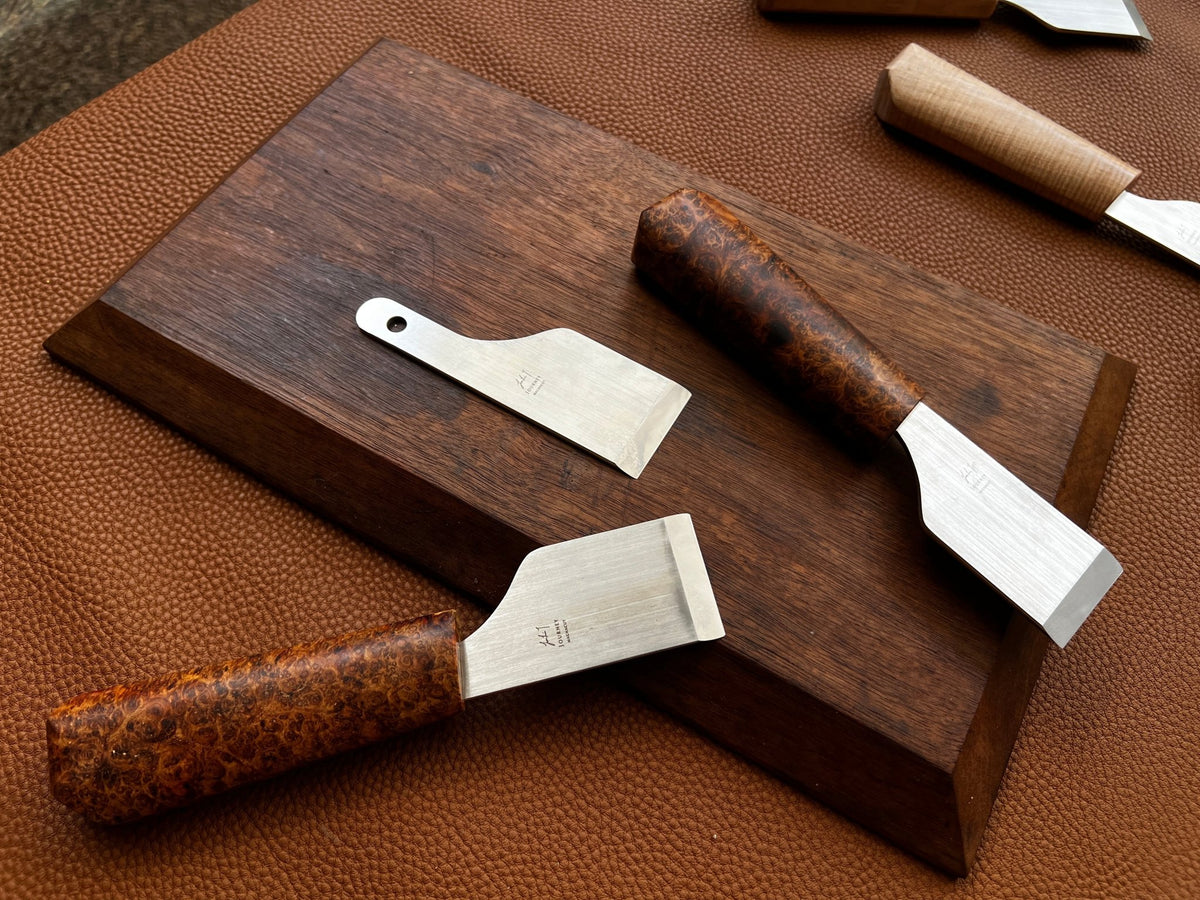
The two recessed grinds are there to reduce the surface area on the flat side of the blade when resharpening.
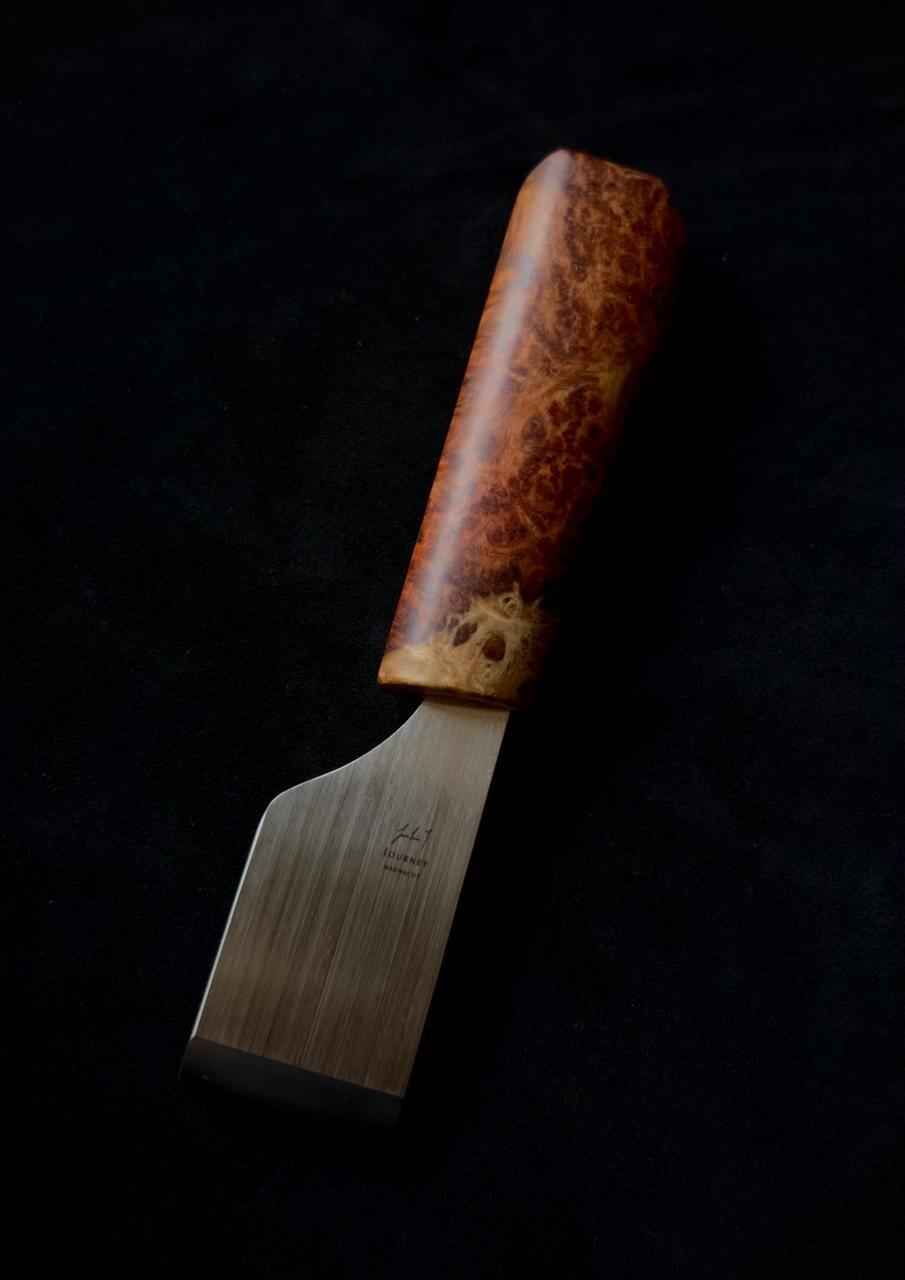
The Journey blade in a stabilized Amboyna burl handle. CPM MagnaCut at 62 HRC, two-stage 15° / 20° bevel — ground for edge retention when cutting, and it skives too.
The handle — stabilized Amboyna burl
Amboyna burl — the burl of the narra tree — is one of the most prized figured woods in the world, and no two blanks share the same grain. Raw burl is unstable, so we stabilize the Amboyna in-house: vacuum-impregnated with an undyed, heat-cured methacrylate resin, pressure-soaked, then cured in a pressurized water bath. The wood keeps its original color and figure but behaves like a composite — dense, sealed against moisture, dimensionally stable. Finished simply with Renaissance Wax, the wood meets your hand directly.
Color varies from golden brown through reddish tones to deep brown. If you have a preference, leave us a note at checkout and we'll do our best to match it.
The bevel — 15° primary, 20° microbevel

A 20° microbevel is genuinely more durable than a 15° edge, and in MagnaCut the difference is especially pronounced. So why not a single 20° bevel? Because a full 20° bevel displaces the leather far more through the cut — on thicker leather, that displacement costs precision and makes the knife much harder to maneuver. The 15° primary keeps the blade thin through the cut, while the 20° microbevel carries the durability at the apex. It also makes light resharpening easy: about ten minutes on the flat back, then refresh the microbevel on a high-grit stone — 3,000 to 10,000 — to re-establish the apex.
The hollow grind

The underside is hollow-ground, CNC-machined into the blade before heat treatment. A single-bevel knife is only as precise as its back: for the edge to be consistently sharp from corner to corner, the flat side must be lapped nearly as flat as a mirror — a flatness achievable only through stone sharpening. Stone flattening is slow, deliberate work, and the hollow grind is what makes it practical: it dramatically reduces the surface area of the back, cutting down the material that must be removed each time the back is lapped. We grind two channels rather than a single uniform hollow — the material retained through the middle of the blade provides greater dimensional stability, keeping the back true over the life of the knife.
Mercury Chamfer
The perimeter of the blade carries a gentle convex, hand ground and polished using a technique we developed, inspired by the spine on Japanese kitchen knives. Your fingers press against the blade constantly in use, and the rounded, polished edge keeps that contact comfortable through long sessions.
Specifications
| Steel | CPM MagnaCut |
|---|---|
| Hardness | 62 HRC |
| Bevel | 15° primary, 20° microbevel |
| Blade | 70 mm long × 36 mm wide |
| Handle | Stabilized Amboyna burl, 105 mm |
| Overall | 175 mm |
| Weight | 100 g |
| Side | Right or left handed |
36 mm and 28 mm are blade widths — 36 mm is the wider. Choose the side that matches your working hand.
Just got this new tool in today and first off, I do not buy cheap when it comes to anything in my shop. I will only entertain quality stuff and everything Ive gotten from this store is quality. This tool is no different unless you might say this is above and beyond. I knew by the description it was going to be quality with the steel type to the handle but the fit and care taken here is outstanding. If you only bought one, you’d be very very satisfied with this one. The sharpest blade on my bench probably right out of the box. Thanks guys, yall are awesome!
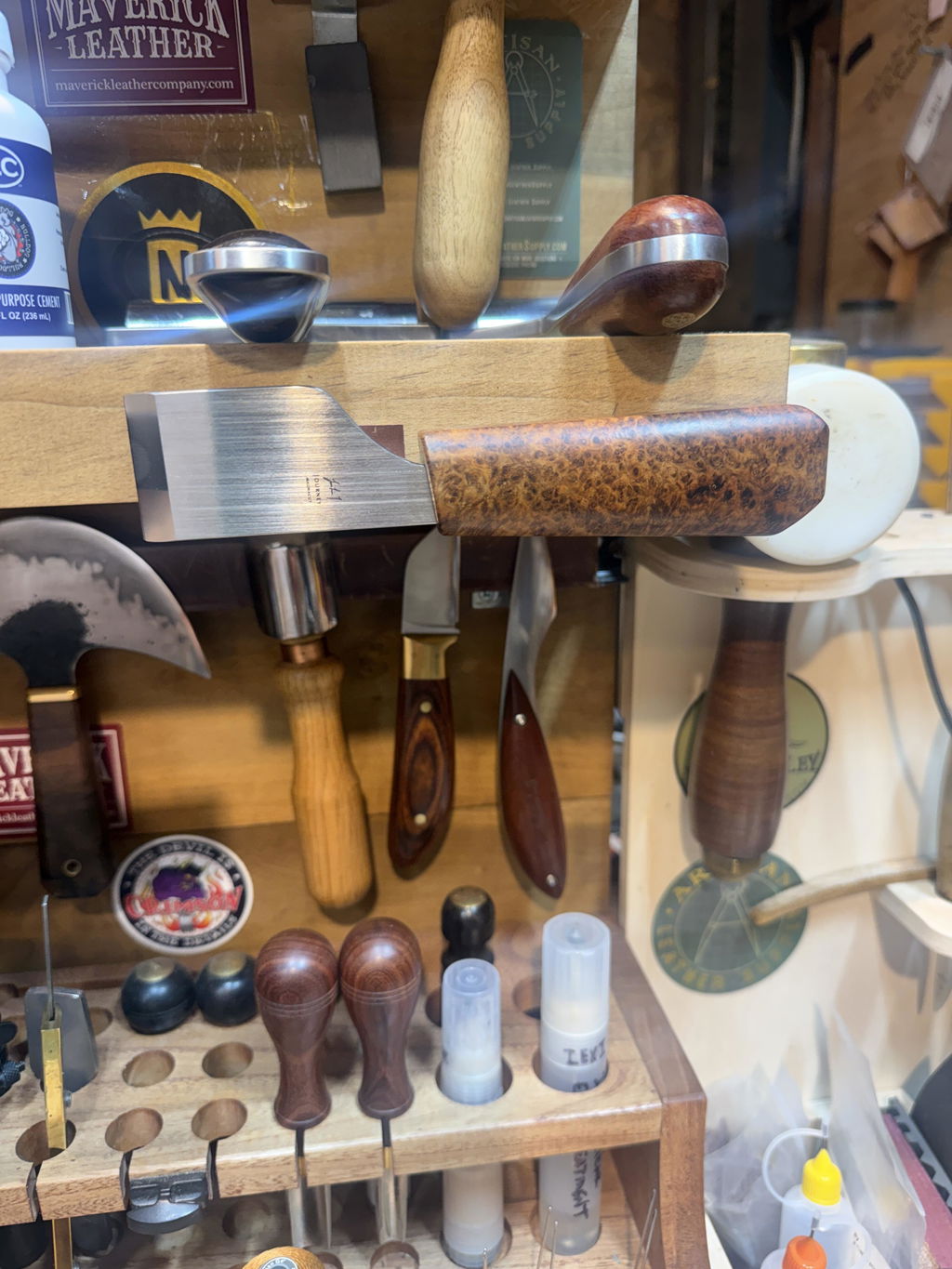
This knife has exceeded all my expectations. The Amboyna burl handle is mesmerizing to look at and it feels extremely solid and premium. The magnacut holds a razor sharp edge and after some light stropping it was sharp enough to whittle hair. Not only is this knife a pleasure to work with, it's also one of (if not the most) beautiful tools I've ever held.